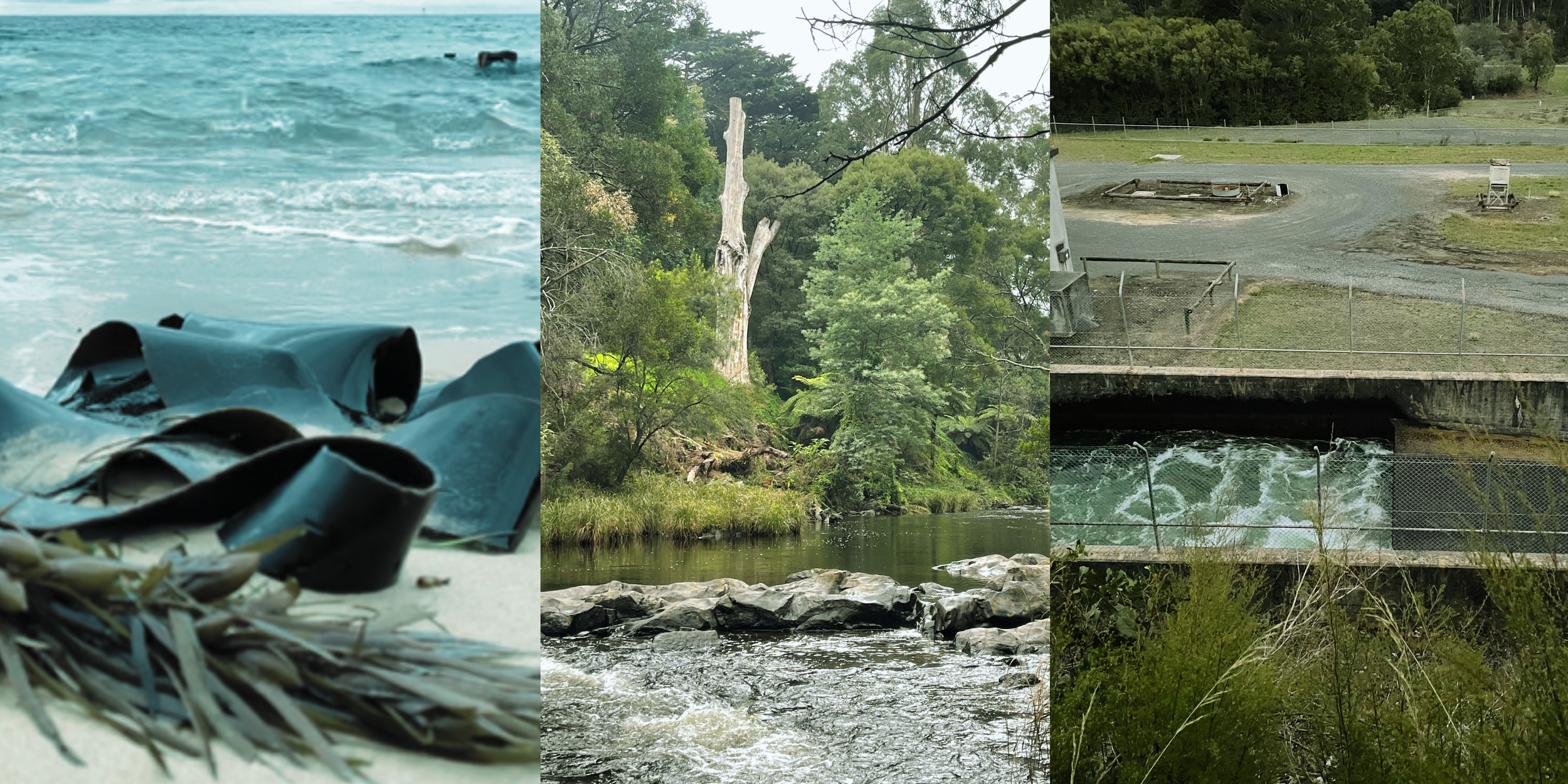
Lab Locations
Nine workshops across three sites develop posthuman methods that carefully navigate intersections and tensions between feminist materialisms, eco-feminisms, socio-technical theory, and Indigenous philosophies.
-
Point Nepean—known in Boonwurrung language as a sentinel point where Port Phillip Bay meets Bass Strait—is Country that holds deep cultural significance and complex colonial histories. This is Boonwurrung land, where the Boonwurrung people have maintained connection and custodianship for millennia, understanding these waters, limestone cliffs, and coastal ecosystems through knowledge systems that recognize the relationality of all beings.
Here, at the narrow opening called The Rip, saltwater currents surge and collide—a meeting place of forces that Boonwurrung people have navigated and understood through intimate knowledge of tides, seasons, and the agencies of water itself. The moonah woodlands, the banksias, the kelp forests offshore—all are part of a living system understood through Yulendj Barring, the Boonwurrung knowledge system that N'arweet Carolyn Briggs teaches. Yulendj Barring recognizes how all things are connected—how the health of kelp relates to the birds, how the limestone holds memory, how the meeting of waters sustains multiple species in reciprocal relationship.
Where Rosi Braidotti's posthumanism challenges anthropocentrism and calls for new modes of relational subjectivity, Yulendj Barring offers an ancient and complete epistemology that has always understood these connections—reminding us that Indigenous knowledge systems are not precursors to posthuman thought but sovereign frameworks that demand recognition on their own terms.
Through yulendj barring, we understand that Point Nepean is not a landscape to be observed but Country that makes demands of us, that teaches us our responsibilities within these connections. What does it mean to engage with a place that has been simultaneously a site of Indigenous resistance, military fortification, quarantine station, and now a "national park," while holding the knowledge that yulendj barring offers about proper relationality?
Any posthuman engagement here must recognize that Boonwurrung sovereignty and yulendj barring offer complete epistemologies for understanding Country's needs and futures. Our responsibility is to learn protocols of reciprocity and care that honor Indigenous custodianship past, present, and future.
-
Coranderrk Station, established in 1863 on Wurundjeri Country, carries layered histories of resistance, self-determination, and ongoing Indigenous presence. This is land where the Wurundjeri people fought for autonomy against colonial control, where they maintained cultural practices and asserted their right to live according to their own laws. Today, Coranderrk asks us to think beyond heritage narratives toward living relationality with Country that continues to teach.
Following the relationality that N'arweet Carolyn Briggs teaches through Yulendj Barring—the knowledge system connecting all things—we might learn to listen differently. Not to extract knowledge, but to understand our responsibilities to Country and to the ongoing sovereignty of Indigenous people. The creek systems, the Mountain Ash, the lyrebirds—these are not resources or even "nature" but kin within a web of obligations and care that precedes and exceeds settler time.
Rosi Braidotti's posthuman philosophy reminds us that zoe—the vital force of life itself—flows through all matter, calling us beyond anthropocentric frameworks toward radical relationality. Yet at Coranderrk, Indigenous knowledge systems have always already known this, have always practiced what it means to be accountable to the more-than-human world as law, not metaphor.
-
The Upper Yarra Reservoir invites us into a thick entanglement of industrial infrastructure and more-than-human worlds. Built 1947 - 1957, this concrete wall holds back the Yarra's flow, creating what we call a reservoir but what might also be understood as an interspecies meeting place—where platypus, eels, and Mountain Ash forests negotiate the terms of coexistence with Melbourne's thirst.
Here, the rights of nature become visceral questions rather than abstract legal frameworks. What does it mean for water to have agency when it's dammed, measured, distributed? How do we attend to the mountain ash regenerating after fire while acknowledging the reservoir's role in the city's metabolic demands?
Through posthuman inquiry, we might ask: whose futures are secured by this infrastructure, and whose are foreclosed? The Wurundjeri Woi-wurrung Country on which this reservoir sits carries knowledge systems that understand water not as resource but as relation. Bringing dadirri—deep listening—to this industrial site means attending to the tensions between ecological rights and engineered systems, between preservation and extraction.
The Australian Posthuman Summer Lab brings together N'arweet Carolyn Briggs' Yulendj Barring—a Boonwurrung knowledge system of Country, kinship, and relational responsibility—with Professor Rosi Braidotti's critical posthumanism, creating a methodology that decenters the human while honoring Indigenous sovereignty and the vital materiality of more-than-human life.
This is a site for thinking-with water's captivity and flow, for considering how infrastructures of survival might become sites of multispecies response-ability.